
Core Features
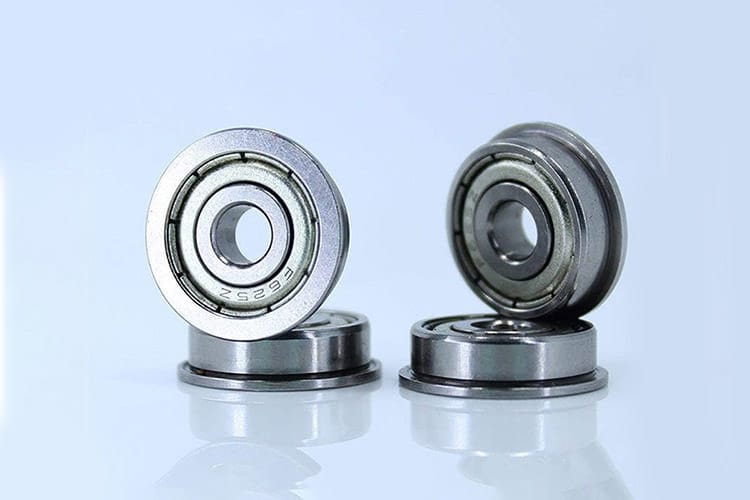
Flanged bearings (also known as flanged bearings) feature a core structure consisting of a base bearing and an integrally molded flange. The flange provides direct axial positioning, eliminating the need for additional shaft shoulder machining or the installation of locating sleeves. These bearings are ideal for applications requiring tight space and precise axial positioning requirements. Their core features include:
Inherent axial positioning simplifies installation: The flange is integrally molded (or welded) with the bearing outer ring. During installation, simply place the flange against the equipment end cover or mounting surface. Axial positioning is achieved by bolting (on select models) or by face-to-face clamping. This eliminates the complex process of machining shaft shoulders and installing retaining rings required for conventional bearings. For example, when installing an F6204 flanged bearing on a small motor, there’s no need to mill a positioning step on the motor shaft. Axial positioning is achieved directly by attaching the flange to the motor end cover, improving installation efficiency by over 40%. Load-carrying characteristics compatible with base bearing types: Flange bearings are often derived from deep groove ball bearings (the most popular), needle roller bearings, or angular contact ball bearings, and their load capacity is consistent with the base bearings:
Deep groove ball flange bearings (such as the F6200 series) primarily support radial loads and secondary support slight bidirectional axial loads (approximately 1/4 to 1/2 of the radial load), making them suitable for low- to medium-load applications.
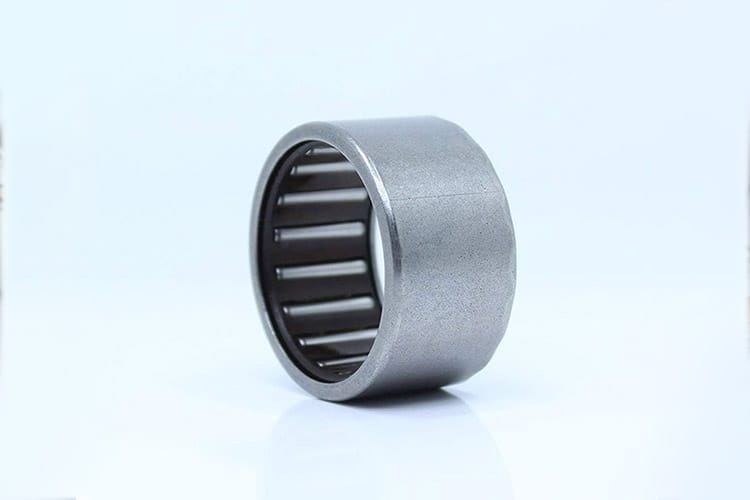
Needle roller flange bearings (such as the NKF series) have high radial load capacity (50% to 80% higher than deep groove ball bearings for the same inner diameter), but do not support axial loads, making them suitable for heavy-load applications in confined spaces (such as automotive door lock motors).
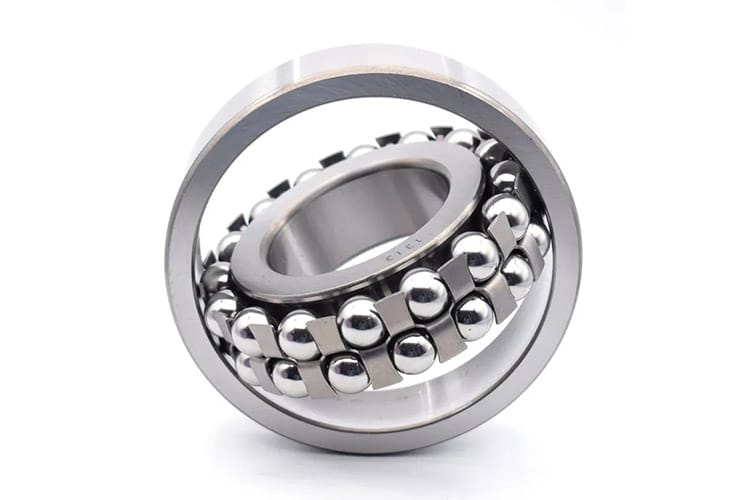
Angular contact ball flange bearings (such as the 7000F series) can support combined radial and unidirectional axial loads, making them suitable for small, precision equipment (such as servo motors). Excellent installation precision and stability: The flange’s end face perpendicularity (typically ≤0.05mm) and outer ring coaxiality (≤0.02mm) are strictly controlled. This ensures the bearing’s coaxiality with the equipment’s shafting after installation, reducing vibration caused by misalignment. For example, when the F608ZZ flange bearing is installed in a printer’s rubber roller, radial runout is controlled to within 0.1mm, ensuring no offset in the printed pattern.
Adaptable to compact spaces: The flange is only 2-5mm thick (depending on the model), reducing axial space usage by 30%-50% compared to a conventional bearing + locating sleeve combination. This makes it particularly suitable for devices with limited dimensions, such as robotic vacuums and small appliances. For example, the F605 flange bearing (5mm inner diameter, 14mm outer diameter, 18mm flange diameter) fits directly into the narrow mounting cavity of a robotic vacuum’s drive wheel.
Application Areas
Flange bearings’ compact mounting and axial positioning make them a key choice for small devices, precision machinery, and automation components. Typical applications include:
Small Motors:
Stepper and Servo Motor End Caps: For example, in 3D printer stepper motors (installed with F6203 bearings), flanges secure the motor end caps to prevent motor shaft movement.
Automotive Electronics: Window lift motors and seat adjustment motors (using NKF30/20 needle roller flange bearings) fit within the confined spaces of doors and seats.
Home Appliance Motors: Robot vacuum drive motors and small fan motors (using F608-2RS flange bearings) offer dust and water resistance and save installation space.
Office and Automation Equipment:
Printer/Copier Rollers: Such as the paper feed roller and fuser roller (installed with F6204ZZ flange bearings) ensure axial stability during high-speed rotation;
Time Attendance Machine and Paper Shredder Transmission Components: Drive shafts within small gearboxes (using F606 flange bearings) simplify the internal structure of the gearbox;
Automated Production Line Barcode Scanners: The scanner head rotating shaft (using F604 flange bearings) achieves precise positioning and low-noise operation.
Smart Home and Consumer Electronics:
Small Appliances: Coffee Maker Water Pumps and Air Purifier Fans (using F603-2RS flange bearings) for dust and splash resistance;
Wearable Devices: Smartwatch Rotating Crowns (using miniature flange bearings, such as the F681X) for lightweight and reliable axial positioning;
Toys and Models: Remote Control Car Drive Wheels and Drone Small Motors (using F6202 flange bearings) for compact fit. Medical Devices and Precision Instruments:
Small diagnostic equipment: Blood glucose analyzer sampling needle drive shafts (using stainless steel F602 flange bearings) are corrosion-resistant and provide precise positioning.
Dental instruments: Small dental handpieces (using 7001F angular contact flange bearings for high-speed rotating components) offer both high speed and axial position control.
Laboratory centrifuges: Microcentrifuge rotor shafts (using F6205ZZ flange bearings) ensure smooth rotor rotation. Common Variants and Accessories
Flanged bearings have multiple models based on the basic bearing type, seal type, and flange structure. The core variants and selection criteria are as follows:
Classification by Basic Bearing Type:
Deep Groove Ball Flange Bearings (F Series, such as F6200 and F6000): The most versatile, suitable for medium-to-low loads and medium-to-low speeds, accounting for over 80% of the market share;
Needle Roller Flange Bearings (NKF Series, such as NKF50/25): Offer strong radial load capacity and are suitable for heavy loads and confined spaces (such as automotive door locks);
Angular Contact Ball Flange Bearings (7000F Series, such as 7002F): Capable of carrying complex loads, suitable for precision motors and small machine tool spindles. Classification by Sealing Type:
Open Type (e.g., F6204): Suitable for dry, clean environments that require regular lubrication (e.g., indoor motors); Lowest cost;
Type with Metal Dust Cover (ZZ Type, e.g., F6204ZZ): Excellent dustproof performance, suitable for dusty environments (e.g., printers, shredders), requiring no frequent lubrication;
Type with Rubber Seal (2RS Type, e.g., F6204-2RS): Dustproof and waterproof with an IP54 rating, suitable for humid, outdoor environments (e.g., robot vacuums, water pumps). Pre-greased at the factory, with a lifespan of 10,000 to 20,000 hours. Classification by flange structure:
Flange-type (flange diameter > outer ring diameter, e.g., F6204: 25mm flange diameter, 28mm outer ring diameter): Offers a large axial positioning area, strong stability, and is suitable for heavy-load applications.
Flat-flange (flange diameter = outer ring diameter, e.g., FP6204): Takes up less axial space and is suitable for extremely compact equipment (e.g., micro motors).
Flange bearings with retaining grooves (e.g., F6204N): Features retaining grooves on the flange edge, allowing for the installation of retaining rings to further secure the axial position. These bearings are suitable for applications with high vibration (e.g., small fans).
By material classification:
Ordinary bearing steel (GCr15, such as F6204): Suitable for normal temperatures and normal loads, with a high cost-effectiveness;
Stainless steel (440°C, such as S-F6204): Highly corrosion-resistant, suitable for wet/corrosive environments such as medical equipment and food processing machinery;
Plastic flange + bearing steel inner ring (such as PF6204): The flange is made of nylon, which is lightweight (30% lighter than the all-steel type) and suitable for low-load applications requiring vibration damping (such as toys and small appliances).
Selection Considerations
Select the base type based on the load: For primarily radial loads, choose a deep groove ball bearing; for heavy loads, choose a needle roller bearing; for combined loads, choose an angular contact ball bearing.
Select the seal and material based on the environment: For humid/dusty environments, choose a 2RS seal; for corrosive environments, choose stainless steel; for lightweight requirements, choose a plastic flange.
Control Speed Limit: The speed limit for deep groove ball flange bearings is the same as for similar deep groove ball bearings (e.g., F6204: ≤12000 rpm); needle roller bearings have lower speeds (e.g., NKF50/25: ≤6000 rpm).
Compatible Installation Space: The flange diameter must be smaller than the maximum size of the equipment’s mounting cavity. (e.g., for a 20mm mounting cavity diameter, choose the F6204 (25mm flange diameter) or the F608 (18mm flange diameter). The model with the flange diameter that fits the mounting cavity is preferred.)