
Core Features
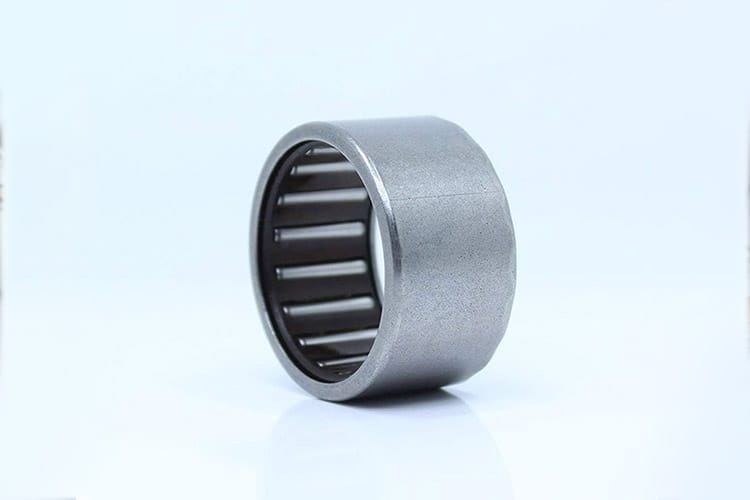
Needle roller bearings offer a core advantage of “small size and high load capacity.” Their design utilizes slender needle rollers (typically with a length-to-diameter ratio greater than 3), delivering robust load-bearing capacity within confined spaces.
Outstanding radial load capacity: The needle rollers utilize a large contact area with the inner and outer ring raceways, significantly exceeding the load capacity per unit volume of similarly sized deep groove ball bearings. For example, a needle roller bearing with the same inner diameter can achieve a radial dynamic load rating of 1.5 to 2 times that of a deep groove ball bearing, making it suitable for heavy-duty applications.
Compact and space-saving: Eliminating the need for large-diameter rolling elements, the bearings offer extremely small radial dimensions, making them suitable for applications with limited space and high load requirements. For example, planetary axles in automotive transmissions require only a 10mm diameter installation space to carry instantaneous loads of several tons.
High precision and low friction: The needle rollers utilize a precision grinding process to achieve a low surface roughness. Combined with hardened raceways, the bearings offer a low coefficient of friction (typically less than 0.0015) during operation, maintaining stable accuracy at low and medium speeds and reducing energy consumption.
Application Areas
The compact, heavy-duty nature of needle roller bearings makes them space-optimizing experts in the automotive, machinery, and home appliance industries:
Automotive Industry: Transmission planetary carriers, clutch release bearings, steering racks, and water pump shafts, adapting to the dense transmission structures within vehicles;
Industrial Machinery: Motor end cap bearings, gearbox auxiliary support shafts, and hydraulic motor rotors, providing heavy-duty support for small and medium-sized machinery;
Home Appliances: Washing machine clutches and vacuum cleaner motor shafts, enabling heavy-duty rotation within the confines of small appliance housings;
Office Equipment: Printer paper feed rollers and copier fuser components, ensuring stable load-bearing even under high-frequency operation.
Common Variants and Accessories
Needle roller bearings have been developed into a variety of specialized models to meet different installation requirements and operating conditions. Core variations include:
With or without an inner ring: Needle roller bearings with an inner ring (such as the NA series) are suitable for applications with lower shaft diameter accuracy and avoid direct wear on the shaft surface. Needle roller bearings without an inner ring (such as the RNA series) require the shaft surface as a raceway and require a shaft surface hardness of ≥HRC58. They are suitable for applications with extremely limited space (such as micro motors).
Seal and Cage Type: Open needle roller bearings (without seals) are suitable for industrial equipment requiring regular lubrication. Models with rubber seals (2RS) or metal dust covers (ZZ) provide dust and dirt protection and are suitable for outdoor or dusty environments (such as agricultural machinery). Cage materials include stamped steel (suitable for medium and low speeds) and plastic (suitable for high-speed, lightweight applications). Combination structure types: Needle roller-thrust ball combination bearings (such as the NKX series) combine the radial load capacity of needle roller bearings with the axial load capacity of thrust ball bearings, suitable for scenarios with combined radial and axial loads (such as automotive steering knuckles). Needle roller-angular contact ball combination bearings (such as the NATR series) offer both heavy load and high speed performance, making them suitable for precision machine tool spindles.